
Equilibrium: How the Vestibular System Supports Balance
In this article
Equilibrium depends on inner-ear signals working with vision and body-position information. The vestibular system supports balance and spatial awareness, but dizziness requires an individual assessment. Research on fear-related brain networks does not establish a new anxiety treatment or an athlete-performance guarantee.
How does equilibrium keep us upright?
When walking down a sidewalk, the fact that we are able to do so without falling may be attributed to our balance system. We are receiving enough information to keep our body upright while avoiding obstacles and changing planes of motion. Our balance depends on combined information from the vestibular system, vision and body-position sensors. Our organ of balance, the vestibular system, is located in the inner ear and allows us to achieve equilibrium.
More than just our balance, this system allows us to have accurate spatial awareness. It can contribute to our moods, such as fear and anxiety, and even our social cognition. Let’s explore this system’s role and the proposed connections with an athlete’s motivation.
What does the inner ear sense?
Before understanding how equilibrium affects us physically and psychologically, we must understand the vestibular system.
The ear is made up of three parts, the outer ear, middle ear, and inner ear. The ear canal is part of the outer ear. The inner-ear labyrinth includes the cochlea and fluid-filled vestibular structures. The cochlea plays a part in the function of the auditory sensory system.
The vestibular part of the labyrinth includes three semicircular canals and the utricle and saccule. Ampullae are enlarged canal regions containing sensory hair cells; they are not the cells themselves.
When the head turns, relative fluid motion bends structures over the sensory hair cells. In turn, the hair cells are stimulated, which allows us to sense the movement.
Once the hair cells detect movement, they send nerve signals to the Central Nervous System (CNS), including the brain. The canal sensors detect rotational motion in different planes.
Additional otolith organs, called the utricle and saccule, lie under the canals. Hair-like cells also line these organs. However, unlike the canals, these organs contain crystals called otoconia (“ear rocks”) in a gel over the sensory hairs.
These cells detect and monitor the position of the head in relation to gravity. They also sense linear motion, which differs from the rotational information gathered from the canals.
Additional organs to help determine our balance include the eyes, auditory sensors of the ear, skin, joints, and muscles. These additional sensors send various messages to the CNS and brain to create a more comprehensive understanding of our surroundings.
However, sometimes these messages might contradict the information obtained from the vestibular system.
How can dizziness affect performance?
It may be easy to assume that equilibrium determines our physical performance due to spatial awareness and perception through information from the vestibular system. If the vestibular system is affected, feelings of dizziness or unsteadiness may result.
Whether standing, sitting, or lying down, we may mistakenly feel we are moving, spinning or floating. If walking, we may feel as if we are falling.
Disorienting feelings of our spatial awareness can physically affect us. We may experience nausea, vomiting, diarrhea, or a change of heart rate or blood pressure.
Such dizziness may affect our ability to interact with the environment, especially during athletic performance.
While an altered vestibular system may internally make us dizzy, externally we may appear to stagger or misjudge the placement of an object. Interaction with the environment will be altered if the vestibular system is altered.
What changes for gymnasts and swimmers?
If a gymnast on a balance beam had an altered vestibular state, they may put themselves in a dangerous state and be prone to injury.
As previously discussed, we have otoconia (ear rocks) in our inner ear. A head injury can displace some crystals into a semicircular canal, contributing to BPPV.
An altered environment can change motion and the sensory cues used for balance.
This can be applied to an athlete such as a swimmer. They spend time in water, thus altering the environment that their vestibular systems need to comprehend.
What does anxiety research actually show?
Our vestibular system utilizes multisensory integration and has multimodal functions.
Beyond the physical effects that vestibular alterations may cause, there are also psychological effects, such as mood changes and information processing.
Emerging evidence has suggested that the vestibular system not only affects our movement, but also our emotions, mental health, and social cognition.
In the past, swinging and rotating chairs have been used to help treat anxiety, mania, and depression.
However, very few studies have demonstrated that continuous bodily motion can improve mood.
Research also suggests that emotion and social contexts impact vestibular processing.
Neumann and colleagues’ 2023 fMRI meta-analysis compared earlier vestibular-stimulation and fear-conditioning studies in healthy volunteers.
Some brain regions showed activation during vestibular stimulation and deactivation during fear conditioning; this was not proof that the entire fear system switches off.
Further research was conducted to find a relationship between the vestibular system and feelings of anxiety.
The authors proposed an interpretation of overlapping brain networks and vertigo-related anxiety. This does not establish deliberately overwhelming balance as an anxiety treatment.
Research explores connections between vestibular function, higher cognition and emotional networks.
Understanding this connection raises questions about an athlete’s training, skills and performance. The imaging findings do not establish that exercising the vestibular system improves motivation, mental focus or sporting results.
Which balance disorders are discussed?
Like other organs of the body, there are diseases and illnesses associated with the vestibular system. However, diagnosis requires assessment of symptoms, history and possible causes. Symptoms and possible contributing conditions include migraine, head injury, motion sickness, dizziness/vertigo, feeling of falling, staggering, lightheadedness, blurred vision, confusion or disorientation, medication, ear infection, low blood pressure, neurological conditions, cardiovascular diseases, postural hypotension, peripheral neuropathy, psychiatric disorders, and hyperventilation.
Benign Paroxysmal Positional Vertigo (BPPV) is a brief, but intense period of vertigo from loose otoconia being displaced and traveling into the semicircular canals. This causes misinformation to be sent through the CNS to the brain.
Meniere’s Disease is composed of a few different symptoms including vertigo, loss of hearing, tinnitus, and a feeling of fullness in the ear. The specific causes of this disease are unknown, but some theories suggest the differing volume of fluid in the ear as contributory.
Labyrinthitis is inflammation or infection involving the inner-ear labyrinth; vestibular neuronitis is inflammation of the vestibular nerve, which may follow a viral illness.
Perilymph Fistula occurs when fluid from the inner ear leaks, and is characterized by unsteadiness, dizziness, and nausea.
Finally, Mal de Debarquement Syndrome (MdDS) is characterized by the continuous feeling of rocking, bobbing or swaying that might be experienced at sea. However, the cause remains unknown.
How are vestibular disorders assessed?
Little is known about how to prevent vestibular diseases, but there are ways to manage such illnesses with various treatment plans.
While diagnosis of a vestibular disorder has always been difficult, there are tests to check parts of the vestibular system.
There are a number of specific tests included in a vestibular test battery.
A videonystagmography measures eye movement and the muscles that control them.
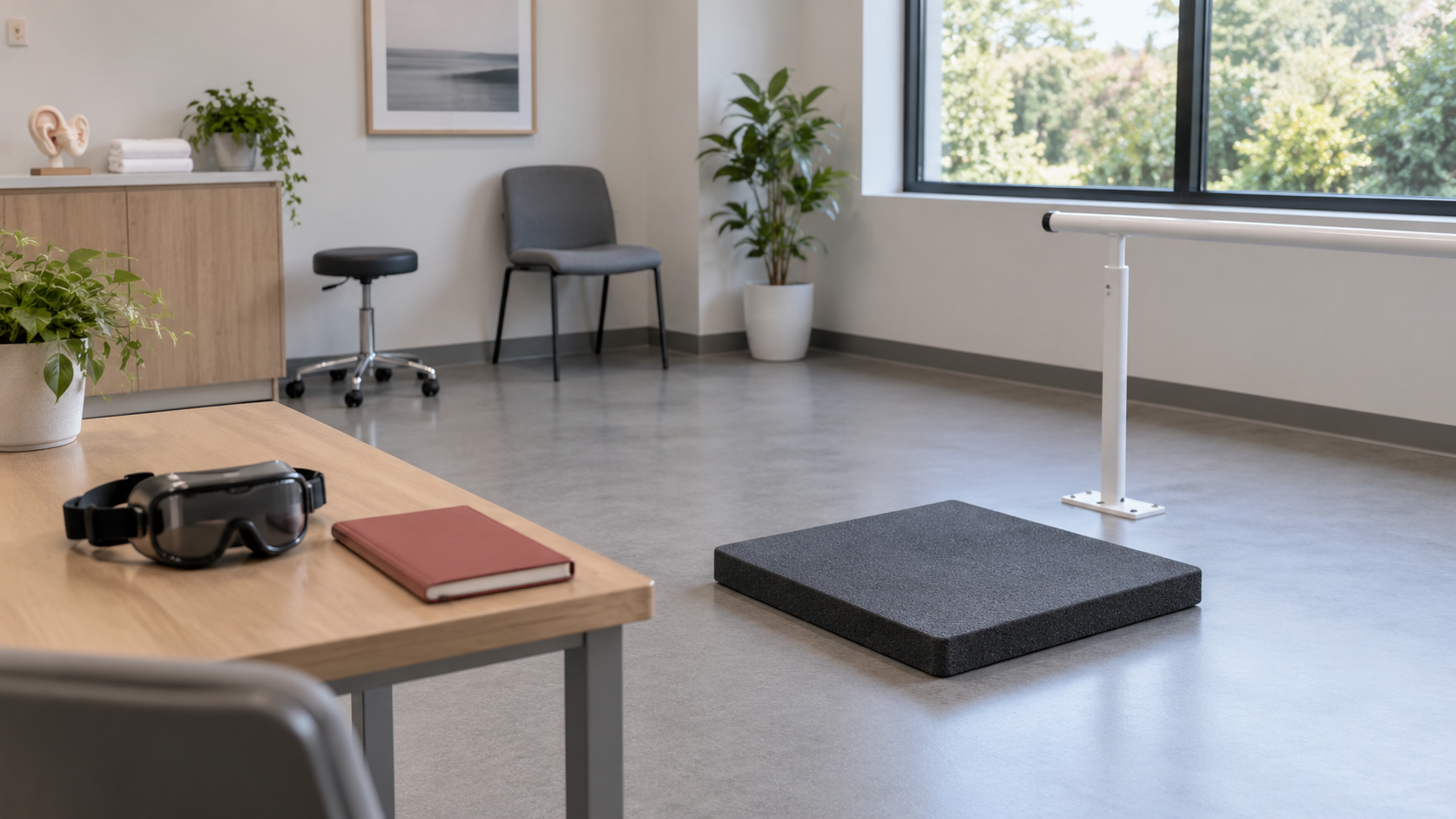
A posturography measures the ability to maintain a steady balance while on different platforms.
A Modified Clinical Test of Sensory Interaction on Balance (mCTSIB) checks how the sense of touch in your feet, vision, and inner ear affects balance.
A Rotary chair tests the reflex connection between the ears and eyes.
A Video Head Impulse Test (VHIT) tests the reflex between the ears and eyes by inducing quick head movements.
A Vestibular-Evoked Myogenic Potentials (VEMP) tests the specific parts of the inner ear.
A Dynamic Visual Acuity Testing (DVA) evaluates how the inner ear balance system works during head movement.
Additional tests may also include a hearing examination, blood tests, or imaging studies of the head and brain.
Clinicians interpret the test patterns together with symptoms and history, including possible health-condition or medication effects. Treatment depends on the particular disorder.
BPPV care may include repositioning movements to move displaced crystals out of a semicircular canal.
If the patient has Meniere’s Disease, a change in diet might be suggested.
Vestibular rehabilitation can be part of an individualized plan; it is not automatically the treatment for every vestibular disorder.
For an athlete, treatment should support a safe return to their game, with timing based on the condition and recovery.
Why call balance the sixth sense?
When considering the function and effects the vestibular system has on the body, it has often been called the sixth sense. Research explores this balance system’s wider roles. The NIDCD fact sheet, updated in 2018, describes research on inner-ear injury, prostheses and diagnostic tests.
Animal studies are being conducted to learn more about the inner ear and how it is affected by age, medication, and trauma.
Other studies are testing vestibular prostheses and tests to accurately diagnose balance disorders.
However, until studies provide positive results, it’s important to learn how the vestibular system can affect our physical performance, spatial awareness, moods, senses of anxiety, fear, and cognition.
References:
Mayo Foundation for Medical Education and Research. (2020, June 18). Balance problems. Mayo Clinic. https://www.mayoclinic.org/diseases-conditions/balance-problems/symptoms-causes/syc-20350474
U.S. Department of Health and Human Services. (n.d.). Balance disorders. National Institute of Deafness and Other Communication Disorders. https://www.nidcd.nih.gov/health/balance-disorders
Balance issues: Common causes & treatments. Cleveland Clinic. https://my.clevelandclinic.org/health/diseases/21021-balance-problems
Mayo Foundation for Medical Education and Research. (n.d.). Inner ear and balance. Mayo Clinic. https://www.mayoclinic.org/diseases-conditions/dizziness/multimedia/inner-ear-and-balance/img-20006286
U.S. National Library of Medicine. (2017, September 7). How does our sense of balance work?. InformedHealth.org [Internet]. https://www.ncbi.nlm.nih.gov/books/NBK279394/
The vestibular system and human dynamic space orientation / by Jacob L. Meiry No.628. HathiTrust. (n.d.). https://babel.hathitrust.org/cgi/pt?id=uiug.30112106584243
Dynamics of the vestibular system and their relation to motion perception, spatial disorientation, and illusions. HathiTrust. (n.d.-a). https://babel.hathitrust.org/cgi/pt?id=uiug.30112107060581
Angelaki, D. E., & Cullen, K. E. (2008, July 21). Vestibular system: The many facets of a multimodal sense. Annual Review of Neuroscience. https://www.annualreviews.org/content/journals/10.1146/annurev.neuro.31.060407.125555
Neumann, N., Fullana, M. A., Radua, J., Brandt, T., Dieterich, M., & Lotze, M. (2023). Common neural correlates of vestibular stimulation and fear learning: an fMRI meta-analysis. Journal of Neurology, 270, 1843–1856. https://doi.org/10.1007/s00415-023-11568-7
Cleveland Clinic. (2023, May 9). What Is Vestibular Testing? https://my.clevelandclinic.org/health/diagnostics/21518-vestibular-test-battery
“Our balance depends on combined information from the vestibular system, vision and body-position sensors.”
“Additional organs to help determine our balance include the eyes, auditory sensors of the ear, skin, joints, and muscles.”
“For an athlete, treatment should support a safe return to their game, with timing based on the condition and recovery.”