
Electrical Muscle Stimulation: EMS, TENS and Fitness
In this article
Electrical muscle stimulation, TENS pain therapy and whole-body EMS fitness suits have different purposes. This history and fitness overview examines those distinctions, the muscle-signaling explanation and how promotional claims relate to evidence.
Where does the history of electrotherapy begin?
Electrical Muscle Stimulation (EMS) uses electrical impulses to evoke muscle contractions, with applications in rehabilitation and fitness.
Bluetens’ commercial history traces ancient electrotherapy to electric fish in Egypt around 2500 BC.
Those practices were not modern physiotherapy or today’s EMS devices.
Initially used for pain relief, it was created by involving electric fish.
The shocks created from the electric fish were used to relieve conditions like arthritis and headaches.
As the world evolved, EMS made another appearance in 1748 by a Swiss physicist named Jean Jallabert.
He had a patient that was paralyzed in one arm and so he dedicated his time to run conclusive testing to find alternative ways to help.
The Bluetens account describes Jallabert using a static electricity generator and reporting recovery in this patient.
This historical account is not a modern controlled trial or a paralysis-cure guarantee.
The later physician it describes using shocks for pain relief is Jean-Paul Marat, not Jallabert.
How did early electrical experiments develop?
Fast forward to 1791, an Italian physicist named Luigi Galvani was the first to provide scientific evidence that electrical current could activate muscles.
Long before this conclusive evidence, Luigi Galvani spent years applying direct electricity to frog legs to watch how the nerves reacted.
Early nineteenth century silver electrodes were introduced by a German pharmacology professor named Christian Bischoff.
This is where the modern medicine world was first introduced to electrical processes being used in therapeutics.
Then, in 1834, the word electrode was derived from the Greek word “elektron” meaning amber and “odos” meaning path from Michael Faraday.
In 1848, the founder of Neurology, G. Duchenne, started using alternating current on the human body.
He observed increases in muscle mass, specifically of the arms among his patients.
He did this by localizing induction electricity into ten-minute sessions, several times a week.
What does the wartime account describe?
As research in EMS continued, equipment began to develop.
The first electrotherapy room opened for therapeutic settings at the Salpêtrière in Paris, France in 1880.
Between 1888 and 1894, promotion of electrotherapy in the medical profession began to spread.
By the early 1900s the electrotherapy processes had become a widespread medical tool used throughout Europe.
In World War 1, military medics were forced to use soldiers as guinea pigs and put them through a series of high-frequency electric shocks to test if that would aid them in war.
The cited history describes coercive treatment of war-related neurological symptoms, rather than a muscle-building program for “better” soldiers.
Unfortunately, this is where EMS slowly started to get a bad reputation.
How did stimulation enter sports?
The Bluetens account places the sports reintroduction in the late 1960s, when a Russian Doctor Yakov Kotz used the technology on the shoulders of an Olympic gymnast.
The account credits his early athlete experiments with stimulating interest in sports use.
This historical report alone does not establish a conclusive muscle-growth result for every athlete.
Unfortunately, EMS in the Olympics was seen as a “technological doping” technique from the years 1971-1976.
Reviewed a decade later, in 1986 EMS was not even investigated again until the French Athletics Federation wanted to truly research the technology.
As always, when new technology surfaces there is initial reluctance and resistance wanting to support the idea.
The same account describes electrostimulation gaining a place in professional sports and medical settings in the late 1990s.
Since then, the use of electrostimulation has been a recovery source for athletes and patients worldwide.
How does TENS differ from muscle stimulation?
Transcutaneous Electrical Nerve Stimulation (TENS) is a pain-relief therapy and differs from EMS designed to evoke muscle contractions.
Now used in rehabilitation like physical therapy or in a sports medicine clinic, the goal is primarily to alleviate pain.
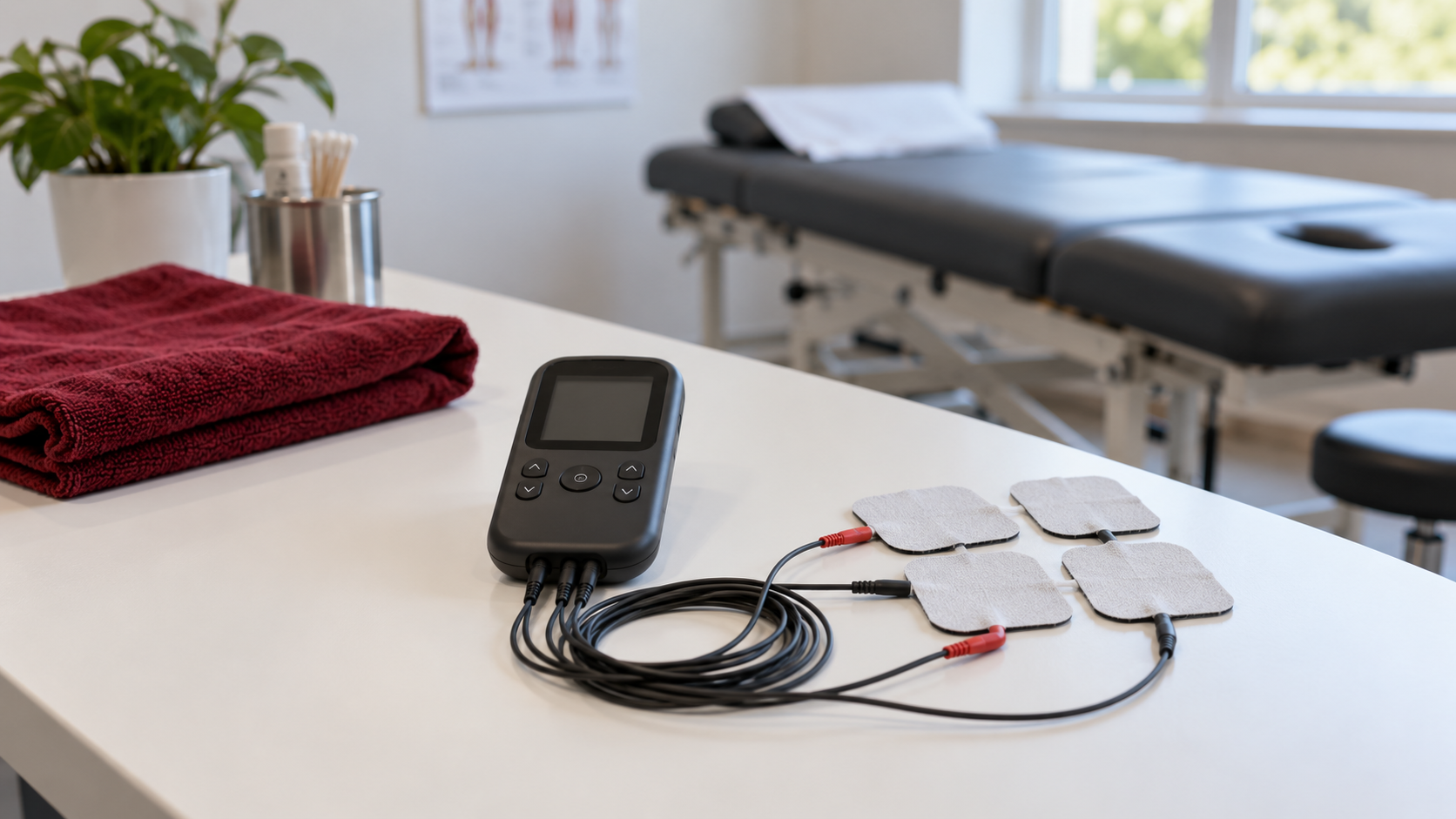
TENS units are battery operated, portable machines that send electrical electrode impulses to the site of pain by the adhesive pads placed on the patient.
Two proposed TENS mechanisms are changing pain-signal transmission and promoting pain-relieving chemicals such as endorphins.
The precise response and degree of relief vary.
The effectiveness depends upon the intensity, frequency, and duration per each pulse.
Intensity is the adjustment of the electrical stimulation level.
Each device is different with a dial ranging from 1-5 or 1-10.
Frequency describes the number of pulses per second.
The cited 80–120 cycles per second range is not the definition of frequency or a setting suitable for every device and person.
TENS is noninvasive, but suitability and settings depend on the condition, device and individual.
TENS may reduce medication needs for some people, but medication changes require the treating provider’s guidance.
This does not establish a reduction in medication abuse.
As learned from earlier years of EMS observation, electrotherapy can have some positive effects on muscle mass.
Instead of simply using it for recovery, the question arose: how to use it to enhance fitness.
To understand the body, the four basics of human movement needed to be studied.
What muscle roles and fitness-suit claims are described?
Conventional training alone makes studying form and function very difficult even with the most compound movements and exercises such as lunges, curls, planks and or squats.
There are agonist muscles which are prime movers that are responsible for creating a specific movement.
Antagonist muscles regulate movement and are located on the opposite side of the limb.
Synergist muscles assist the prime mover in an action.
Their role is defined by what they do, rather than by being small or surrounding other muscles.
Stabilizer muscles help steady a joint or attachment while movement occurs.
This role is not defined by small muscle size.
Knowing all of this, XBODY, whose site identifies XBody Hungary Ltd., markets a system for stimulating several major muscle groups simultaneously.
That does not establish that conventional exercise cannot recruit movers, antagonists, synergists and stabilizers together.
This includes experienced athletes and gym goers who are used to hours of training.
XBODY was able to create a suit that takes the electrical impulses used for recovery EMS and changed the frequencies to strengthen and condition muscle.
These new passive, artificial impulses would be able to contract muscles similar to normal contractions.
How do nervous-system signals and EMS differ?
Following traditional strength workouts lead to how this technology was created.
Voluntary movement involves signals from the nervous system reaching skeletal muscles through motor neurons and neuromuscular junctions.
But it is not just as simple as it sounds.
Skeletal muscles receive motor-nerve input.
The rationale for EMS is not that some muscles lack normal nervous-system connections.
An EMS suit applies external electrical stimulation to evoke contractions.
Electrical stimulation can activate motor nerves without the usual voluntary command, but recruitment depends on electrode placement, current and tissue characteristics.
It does not make all large and small muscles contract equally.
Whole-body EMS can be a time-efficient training option, but its effects depend on the person, application and training program.
Electrically evoked recruitment differs from voluntary exercise, but this does not establish a guaranteed accelerated-fiber mechanism or extra post-workout calorie burn for every user.
But there was the question of how often to train and workout with this kind of suit technology to reap the benefits.
XBODY promotes short sessions and time-efficient results; the cited promotional material does not establish one half-time equivalence to conventional training.
The promotional comparison of twenty-minute XBODY workouts with ninety minutes of gym training is not a universal equivalence established by the cited material.
A proposed twice-weekly strength and three-day cardio schedule is not sufficient or appropriate for every user.
The manufacturer markets benefits involving muscular balance, posture, metabolism, muscle gain and fat loss.
Those broad claims need device- and outcome-specific evidence.
The FDA states that reviewed EMS uses do not by themselves establish weight-loss or girth-reduction claims.
What should shape suitability and supervision?
Applying EMS in such a manner is not far off.
Clinical rehabilitation uses of electrical stimulation do not by themselves validate every commercial whole-body fitness claim.
To fully gain public trust in the technology, there must be proper user training and understanding of the technology before use.
Special safety training and protocols must be discussed and be in place to minimize the risk of injury and overuse of equipment.
Everyone has different goals, desires, and differing body compositions, so it is important to research a wide variety of users.
An evaluation of prior medical history to ensure users do not have any contraindications that would prevent them from equipment use would be logical.
The brand describes its own approved-trainer education.
The 2023 international expert recommendations also emphasize qualified close supervision and individual screening; excessive initial WB-EMS intensity has been associated with serious muscle injury, including rhabdomyolysis.
The trainers must understand the special effects of EMS, stimulation parameters, supercompensation characteristics through XBODY’s education system called EMS Trainer Institute.
Here is where trainers will not only learn how to operate the EMS device.
They will also learn how to supervise, motivate, follow equipment guidelines, use best practices and how to help clients reach optimal results.
Whether EMS fits your goals depends on the device, evidence, individual suitability and qualified guidance.
References
Delahodde, C., & Bluetens. (2020, October 1). History of electrostimulation. Bluetens. Retrieved November 30, 2022, from https://www.bluetens.com/de/blog/Beitrag/elektrostimulationsgeschichte.html
Clinic, Cleveland. “Transcutaneous Electrical Nerve Stimulation (TENS).” Cleveland Clinic, Retrieved 15 Jan. 2020 from https://my.clevelandclinic.org/health/treatments/15840-transcutaneous-electrical-nerve-stimulation-tens
Body20. Operations Manual, BODY20, Boca Raton, FL, 2018.
EMS, XBODY. “Xbody EMS Training – Whole-Body Electric Muscle Stimulation Training.” XBody, 23 May 2022, https://xbodyworld.com/about-ems-training/
U.S. Food and Drug Administration. Electronic Muscle Stimulators. https://www.fda.gov/medical-devices/consumer-products/electronic-muscle-stimulators
Khalil, B., Marwaha, K., & Bollu, P. C. Physiology, Neuromuscular Junction. StatPearls/NCBI Bookshelf. https://www.ncbi.nlm.nih.gov/books/NBK470413/
Kemmler, W., et al. (2023). Position statement and updated international guideline for safe and effective whole-body electromyostimulation training—the need for common sense in WB-EMS application. Frontiers in Physiology. https://doi.org/10.3389/fphys.2023.1174103
Royal Institution. History of research at the Ri. https://www.rigb.org/explore-science/explore/collection/history-research-ri
OpenStax. Anatomy and Physiology, Chapter 11 Key Terms: agonist, synergist and fixator. https://openstax.org/books/anatomy-and-physiology/pages/11-key-terms
“Electrical Muscle Stimulation (EMS) uses electrical impulses to evoke muscle contractions, with applications in rehabilitation and fitness.”
“These new passive, artificial impulses would be able to contract muscles similar to normal contractions.”
“Whole-body EMS can be a time-efficient training option, but its effects depend on the person, application and training program.”