
Fat Facts: Omega-3, Omega-6 and Easy Recipes
In this article
Why are fat choices so confusing?
We have received so much mail about conflicting information about Omega 3 and Omega 6 oils, I thought it would be a good opportunity to review…
Lately, it seems that we’re hearing ever-changing recommendations on what we should eat or not eat.
One day fat is the enemy, the next day it’s sugar. Don’t eat too much seafood! Wait, fish is now the new superfood!
There’s a lot of confusing information out there on healthy eating. Possibly the most confusing topic is the omega fats.
Although we hear and read about omega-3 and omega-6 everywhere, it’s hard to know how much of these we need, and in what forms.
Omega-6 is an essential part of the diet, not a nutrient to eliminate.
But how do we sort all this out?
Read on for ideas about choosing fats and making easy dishes at home.
What makes a fatty acid essential?
The omega-3 fat alpha-linolenic acid (ALA) and the omega-6 fat linoleic acid are essential fatty acids. We need them from food because our bodies cannot make them.
So, we must get them from the foods we consume.
The overall eating pattern matters more than treating one omega ratio as a guarantee of health.
The American Heart Association includes omega-6-rich foods and oils in a healthy diet.
What do omega ratios tell us?
According to Healthline.com, scientists have hypothesized that a diet high in Omega-6s but low in Omega-3s increases inflammation. But a single optimal omega-6-to-omega-3 ratio has not been defined.
They go on to say that ancient hunter-gatherers who ate mostly land animals consumed these fats at ratios between 2:1 to 4:1. The Inuit people, who eat mostly Omega-3 rich seafood, consume a ratio of 1:4. Other pre-industrial populations are somewhere in between.
A Sciencedirect.com article on evolutionary aspects of diet, stated that human beings evolved on a diet with ratios of Omega-6 to Omega-3 essential fatty acids of 2:1 to 4:1. But in modern western diets the typical ratio is an astonishing 15:1!
Those historical ratio estimates do not by themselves establish an individual’s disease risk.
Where do omega-6 fats appear?
Where do omega-6 fats appear in our diet?
The SAD contains more processed and packaged foods than humans have ever consumed.
Omega-6, most commonly found in corn oil, soybean oil and other seed and vegetable oils, is used in many processed foods.
Corn and soybean oils are among the liquid plant oils the American Heart Association lists as healthy choices.
Feed can influence an animal product’s fatty-acid profile, but a non-organic label does not establish that the food is inflammatory.
Choices can reflect nutrition, cost and animal-welfare priorities.
How should we think about fats and health?
Omega-6 intake is not established here as a direct cause of high blood pressure, blood clots or fluid retention. Replacing saturated fats with unsaturated fats can support heart health as part of an overall eating pattern.
According to Healthline.com, chronic inflammation may be one of the leading factors associated with some of the most serious (and common) modern diseases, including heart disease, metabolic syndrome, diabetes, arthritis, Alzheimer’s, and many types of cancer!
Meanwhile, we typically don’t consume enough Omega-3 essential fatty acids.
Omega-3s can be part of a heart-healthy eating pattern, but they are not a guarantee against cancer or other diseases.
Fish provides EPA and DHA; flaxseed, hemp and walnuts provide ALA, and some leafy vegetables contribute smaller amounts.
How can we choose fats at home?
But fear not! There is a solution to this nutritional problem. We are all able to make better choices, and it’s pretty easy to do.
You can start by looking at the overall balance of foods and fats you use. There is no need to eliminate all vegetable oils simply because they contain omega-6.
At home, cook with olive oil or avocado oil.
These can be useful cooking choices, alongside other unsaturated plant oils; no single oil is best for every purpose.
Replace packaged condiments such as soy-based mayonnaise and salad dressings with homemade versions using only these oils.
See below for ideas for these! You will never go back once you’ve tasted homemade mayo!
Compare ingredient lists and choose foods that fit your overall eating pattern. Some packaged snacks contain substantial added sugars or saturated fat; packaging alone does not tell the whole story.
Include omega-3-rich foods without treating omega-6-rich foods as something to eliminate.
A balanced eating pattern does not guarantee better mental function or prevention of every inflammation-related disease.
At home, eat more wild-caught fish, leafy greens, and walnuts.
Make the switch to organic, free range, certified humane animal products.
These choices can reflect your preferences and animal-welfare priorities, but paying more is not proof of an anti-inflammatory benefit.
Regard this as an investment in yourself.
Chronic inflammation can be involved in disease, but that does not make a food’s omega-6 content a diagnosis or a direct cause of every illness.
What choices can we make when dining out?
When dining out, stay away from ordering fried foods.
Skip the fries and order a side salad instead.
Ask for olive oil and vinegar, instead of the typical soy-based salad dressings.
If it’s not available, use a squeeze of lemon. Ask how things are cooked; you can request olive oil if you prefer it.
Whether at home or dining out, you need to be your own best advocate for healthy eating.
These changes can help you build meals you enjoy, alongside an overall pattern that supports health.
You’ll enjoy better health while enjoying better taste! Cheers…!
Here are three homemade recipes to try.
Simple Shot-Glass Salad Dressing
Now, this is so easy it’s just silly!
You can change it up any number of ways, just remember the 2:1 ratio of oil to acid…
Using a shot glass, pour 1 oz of your favorite vinegar (red wine, sherry, balsamic, you name it!) or citrus juice into a small jar.
Next, add 2 shots of olive oil.
Add ¼ teaspoon Dijon mustard and any seasonings you like; such as fresh herbs or crushed garlic.
Shake it vigorously. It’s healthy and ready in a minute!
Mason Jar Mayo
I use an inexpensive “stick blender” for this. Place two pasteurized whole eggs, a clove of garlic for flavor, the juice of half a lemon, a pinch of salt, and a ½ teaspoon of Dijon mustard.
Put it all in a mason jar with 1 cup of Avocado Oil or Extra-Virgin Olive Oil.
Blend for 1 minute, or until smooth (the stick blender makes it SO easy).
Soon you will have some of the best tasting mayo WITHOUT any soy.
Try it, you won’t go back…!
Keep the mayonnaise refrigerated and handle it as a perishable egg-containing food.
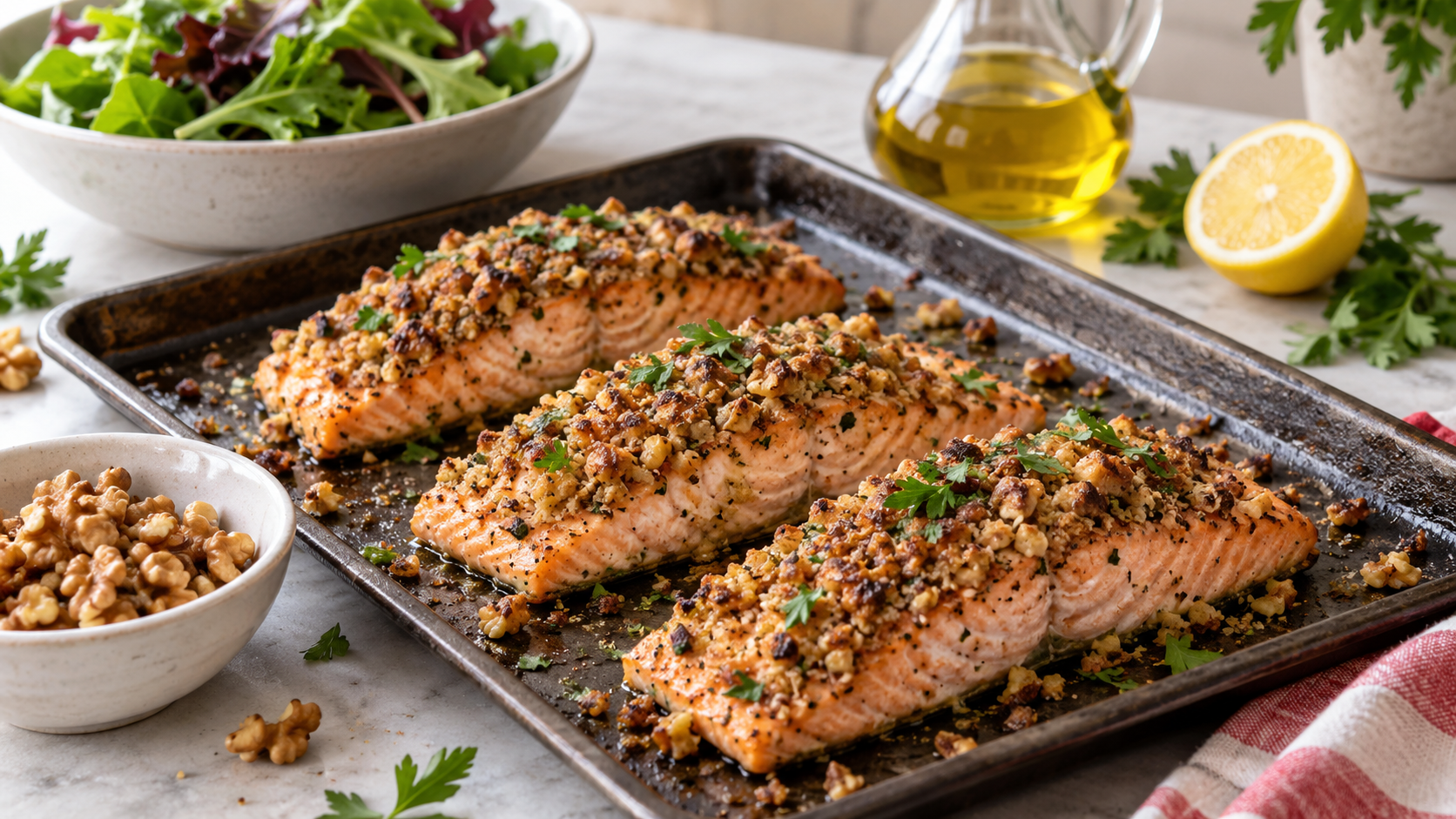
Walnut Crusted Salmon
3 oz walnuts (or pistachios, pecans, etc.)
2 tablespoons olive oil
½ cup chopped Italian parsley
1 teaspoon Dijon mustard
Two 6 oz salmon filets
In a mini food processor, coffee grinder or mortar and pestle, grind the walnuts up with the olive oil and parsley to make a paste.
Add some salt and pepper to taste.
Brush each salmon filet with a little Dijon mustard, then press the walnut paste mixture on to each.
Bake at 350°F for about 15 minutes, checking that the salmon reaches an internal temperature of 145°F with a food thermometer; cooking time varies with thickness.
Impressive & Yummy…!
References
National Institutes of Health, Office of Dietary Supplements. Omega-3 Fatty Acids: Health Professional Fact Sheet. https://ods.od.nih.gov/factsheets/Omega3FattyAcids-HealthProfessional/
American Heart Association. Healthy Cooking Oils. https://www.heart.org/en/healthy-living/healthy-eating/eat-smart/fats/healthy-cooking-oils
American Heart Association. Fats in Foods. https://www.heart.org/en/healthy-living/healthy-eating/eat-smart/fats/fats-in-foods
American Heart Association News. There’s no reason to avoid seed oils and plenty of reasons to eat them. August 20, 2024. https://www.heart.org/en/news/2024/08/20/theres-no-reason-to-avoid-seed-oils-and-plenty-of-reasons-to-eat-them
U.S. Food and Drug Administration. What You Need to Know About Egg Safety. https://www.fda.gov/food/buy-store-serve-safe-food/what-you-need-know-about-egg-safety
U.S. Food and Drug Administration. Selecting and Serving Fresh and Frozen Seafood Safely. https://www.fda.gov/food/buy-store-serve-safe-food/selecting-and-serving-fresh-and-frozen-seafood-safely
“The American Heart Association includes omega-6-rich foods and oils in a healthy diet.”
“Feed can influence an animal product’s fatty-acid profile, but a non-organic label does not establish that the food is inflammatory.”
“Whether at home or dining out, you need to be your own best advocate for healthy eating.”