
Amputee Athletes and Their Critics in Sports
In this article
Amputee athletes train, compete and navigate physical and social challenges. Aniya Dixon argues for recognition of their effort, explains running prostheses and considers the 2022 research on elite bilateral-amputee sprinting. Those specific race comparisons do not establish an advantage rule for every sport or prosthesis.
Why does recognition matter for amputee athletes?
The mindset change that occurs when an individual becomes an amputee can be life changing. They are forced to learn a new way of living that requires them to relearn day-to-day movements, and face challenges negotiating limitations. Maneuvering around with a prosthetic can also affect their motivation and self-esteem due to reasons such as the judgement and doubt that society puts onto amputees.
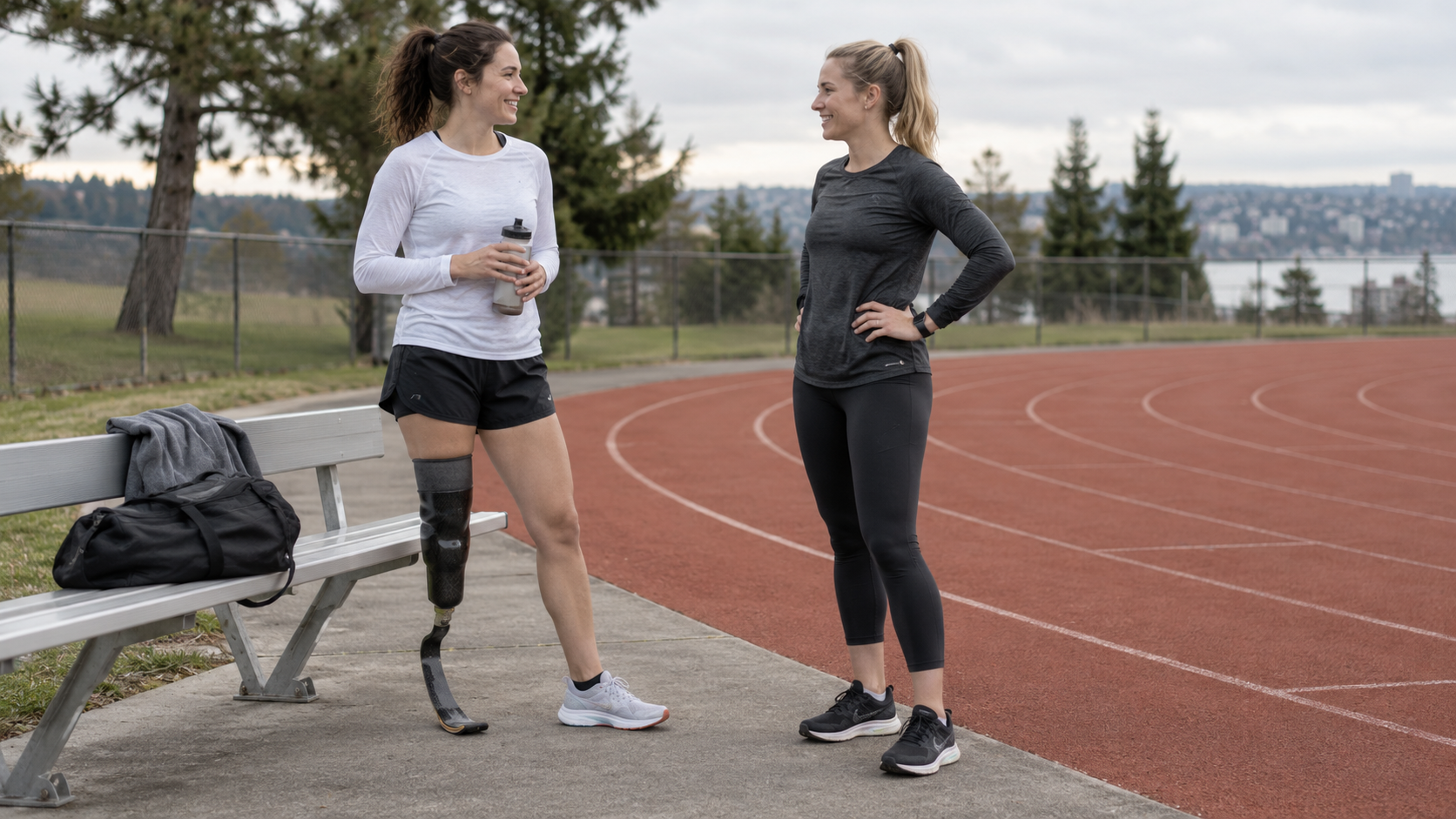
Although, this transition can be traumatic for some, others have chosen to test these limitations and participate in competitive sports. Because amputee athletes put in time to train just like non-amputee athletes do, they deserve to receive the same recognition for their athletic ability. Despite the various opinions on amputee athletes, they have just as much motivation as non-amputee athletes.
Special equipment has been developed to enable them to compete, and the cited sprinting research raises questions about assumed advantages, rather than establishing one rule for every prosthesis or competition. These are a few reasons why athletes that are part of the amputee community should not be judged differently.
What challenges and motivations do amputee athletes describe?
Amputees who participate in sports have the unique opportunity to display their hard work and motivation. Staying motivated to perform high intensity exercise while in discomfort makes the effort more noteworthy than society realizes. It indicates how much amputees commit to making a difference for themselves.
They are purposefully choosing a better way of living when all odds are against them. In the 1987 article The Amputee Athlete, Richard Riley, writing about sports prosthetics, stated, “Most amputee athletes are highly motivated individuals with a strong desire to overcompen-sate for their disability. A percentage of these people will rehabilitate themselves with practically no help at all and go on to accomplish great things in their personal lives as well as in sports.” This quote illustrates that a disability does not define someone.
The decisions that they make allow them to make a name for themselves. Becoming an athlete as an amputee is not an easy choice. It takes someone who is willing to redefine expectations to take on the journey.
Pain and residual-limb loading are among the physical challenges described in Riley’s 1987 discussion of athletic prostheses. As Riley continued to explain the psychological challenges of athletic amputees, he stated “Pain is an aspect of amputation that in many cases is initially the greatest barrier to overcome…The amputee athlete not only has the pain of general physical exertion to deal with, but also the added trauma of torques and stresses far beyond normal to the skin and bone structure of the residual limb.” Riley’s account describes pain from physical exertion alongside additional stresses on residual-limb skin and bone. The passage describes potential challenges rather than a measured pain comparison between all amputee and non-amputee athletes.
They are applying force and high amounts of energy to perform as any athlete. Riley describes additional mechanical stresses that may affect residual-limb skin and bone. This suggests why amputee athletes should receive more positive recognition.
An amputees’ motivation is unique to their own journey. It comes from a place where it is all too easy to settle for less rather than aiming for the highest level of success. There is only so much control that an amputee can have over their prosthetic.
It is the psychological strength they must possess to remain strong and motivated.
How do running prostheses support athletic movement?
There are different types of prosthetics with a range of functions that give amputees the ability to perform higher mechanical movements. Studies have been conducted to evaluate how a prosthetic works and how closely it mimics a biological limb. The existence of these prosthetics gives amputees the chance to commit to being an athlete and to compete against non-amputee athletes.
The research article Sprinting with prosthetic versus biological legs: insight from experimental data briefly describes how running prostheses are made and how they function during a study against a non-amputee athlete. Alena Grabowski, identified in the 2022 source as an associate professor of integrative physiology at the University of Colorado, and her coauthors wrote, “These athletes achieved world-class performances by combining their unique physiology with passive-elastic carbon-fiber running-prostheses that act in-series with their residual limbs.” The quoted explanation describes passive-elastic carbon-fiber running prostheses acting with the residual limbs. Essentially, they replicate the spring-like effect that can be seen when the body accelerates.
Running prostheses are intriguing in the way that they function. Even with the limitations of not having a full range of motion like a biological leg, they have been manufactured to give an amputee the best sense of mobility. Therefore, amputee athletes are more than capable of being in a competition with peers who may not have the same structure.
When addressing the different types of prostheses for athletes, editor Larry Greenemeier spoke on the usage of blade prostheses and stated, “Blade prostheses, like Rehm uses on his right leg and Pistorius used on both, share some characteristics with biological limbs. The blades store energy as they bear the runner’s weight and then release it as the runner pushes off the ground, much the way a leg’s calf muscles and Achilles’ tendons spring and recoil.” Blade prostheses are used by many amputees who either run track or engage in distance running. The article highlights that there are some athletes who have two prosthetic legs and still chose to challenge themselves with what they believe they can do.
Although an advanced style of a prosthetic may not function the same as a biological leg, it can still perform at higher standards from an athletic perspective.
What does 2022 prosthetic sprinting research show?
Along with the judgement that society has about amputee athletes, there is some controversy if these athletes may have an unfair advantage over non amputee athletes. Some claim that there is a difference in how the body exerts energy and produces speed. This has caused some amputee athletes to be banned from competitions or asked to provide proof that their prosthetic gives them no advantage.
Editor Larry Greenemeier stated, “Once a runner on blades accelerates to top speed, one potential advantage lies in the ability to move the prostheses faster and with less effort—because the blades weigh less than a competitor’s lower legs and feet.” Although, this may seem like an advantage, athletes with prosthetics have much more physical and mechanical boundaries than non-amputee competitors. A prosthetic is set to a specific molding of a leg and cannot be adjusted like a biological leg. Alena Grabowski is an advocate for amputee athletes and has conducted several studies that examine if there is an advantage or disadvantage between the two types of athletes.
A study involving bilateral-amputee sprinting data was discussed in the 2022 article World’s fastest blade runner gets no competitive advantage from prostheses, study shows. “We found that no athlete with prosthetic legs has ever performed better than elite non-amputee athletes in lab-based experiments in any measure that relates to sprinting performance,” said Owen Beck in the university article. The report stated that athletes using prostheses were 40% slower out of the starting blocks, had 19% slower velocity at aerobic capacity and were 1 to 3% slower around curves compared to non-amputees. The team’s comparisons address elite bilateral-amputee sprinting and specific race metrics, including acceleration, curves and velocity at aerobic capacity.
They should not be generalized to every amputee athlete, prosthesis, sport or type of aerobic exercise. The 2022 report found no clear advantage over 400 meters in those comparisons. Performing as an athlete with a prosthetic shows how committed these athletes are to being psychologically and physically strong.
How did later papers challenge the 2022 conclusions?
Later publications place those findings in a disputed research context. Weyand and colleagues’ 2022 comment challenges the comparison standard and highlights prosthetic limb length. A 2023 comment by Connick, Beckman and Tweedy describes the corrected work as a case study and disputes the analysis. The paper also carries a 2023 correction to its research-ethics statement. These reports should be read together rather than treated as one general rule about competitive advantage.
How can society recognize athletes beyond appearance?
Despite the mechanical limitations and psychological boundaries that come with having a prosthetic, amputee athletes are some of the most motivated and they deserve recognition. These are the people that can stay motivated during the toughest times of life. Not everything comes easy in life, but these athletes have decided to test their limits and rewrite the narrative on people with prosthetics.
There is no reason to limit someone’s ability to perform if equipment has been made specifically for amputees who wish to become a competitive athlete. Studies have been conducted and products have been made to give them the widest athletic career possible. Amputee athletes are well aware of how differently their bodies may function compared to their competitors.
Overall, amputee athletes should not be defined by their appearance. Society should understand that it is unfair to take away the dreams and opportunities to allow these athletes to flourish.
References
Beck, O. N., Taboga, P., & Grabowski, A. M. (2023). Correction to “Sprinting with prosthetic versus biological legs: insight from experimental data”. Royal Society Open Science, 10, 230483. https://doi.org/10.1098/rsos.230483
Weyand, P. G., et al. (2022). Artificially long legs directly enhance long sprint running performance. Royal Society Open Science, 9, 220397. https://doi.org/10.1098/rsos.220397
Connick, M. J., Beckman, E. M., & Tweedy, S. M. (2023). Sprinting with bilateral transtibial running-specific prostheses versus biological limbs – are they comparable? Comments on Beck et al. (2022). Royal Society Open Science, 10, 230086. https://doi.org/10.1098/rsos.230086
“The mindset change that occurs when an individual becomes an amputee can be life changing.”
“Amputees who participate in sports have the unique opportunity to display their hard work and motivation.”
“An amputees’ motivation is unique to their own journey.”