
Fitness Apps: Choosing Workouts and Remote Training
In this article
Your phone can hold a training plan, a running route or a way to check in with a trainer. Choosing a fitness app starts with what you want to do and what will help you do it regularly.
Think about the workout as well as the screen. You need room to move, any equipment the session uses and a plan that fits your week. You may also want someone to answer questions or encourage you when a session feels hard.
What should you check before choosing a fitness app?
Start with the activity you enjoy or want to learn. Running, yoga, Pilates and body-weight workouts make different demands on your space and equipment. Check a sample session before deciding whether it will work where you plan to exercise.
An app may offer a lower-cost option than a class or gym membership, depending on the service and equipment you need. Compare the whole cost and the support included. A cheap plan that needs equipment you do not have may be a poor fit.
| What matters to you? | What should you check? |
|---|---|
| The workout | Does the app offer the activity you want to do, at a level you can follow? |
| Space and equipment | Can you complete a sample session with the room and equipment you have? |
| Encouragement and feedback | Will you train alone, share progress with friends or have contact with a trainer? |
| Cost | What will the app, equipment and any extra coaching cost together? |
How can remote training fit your week?
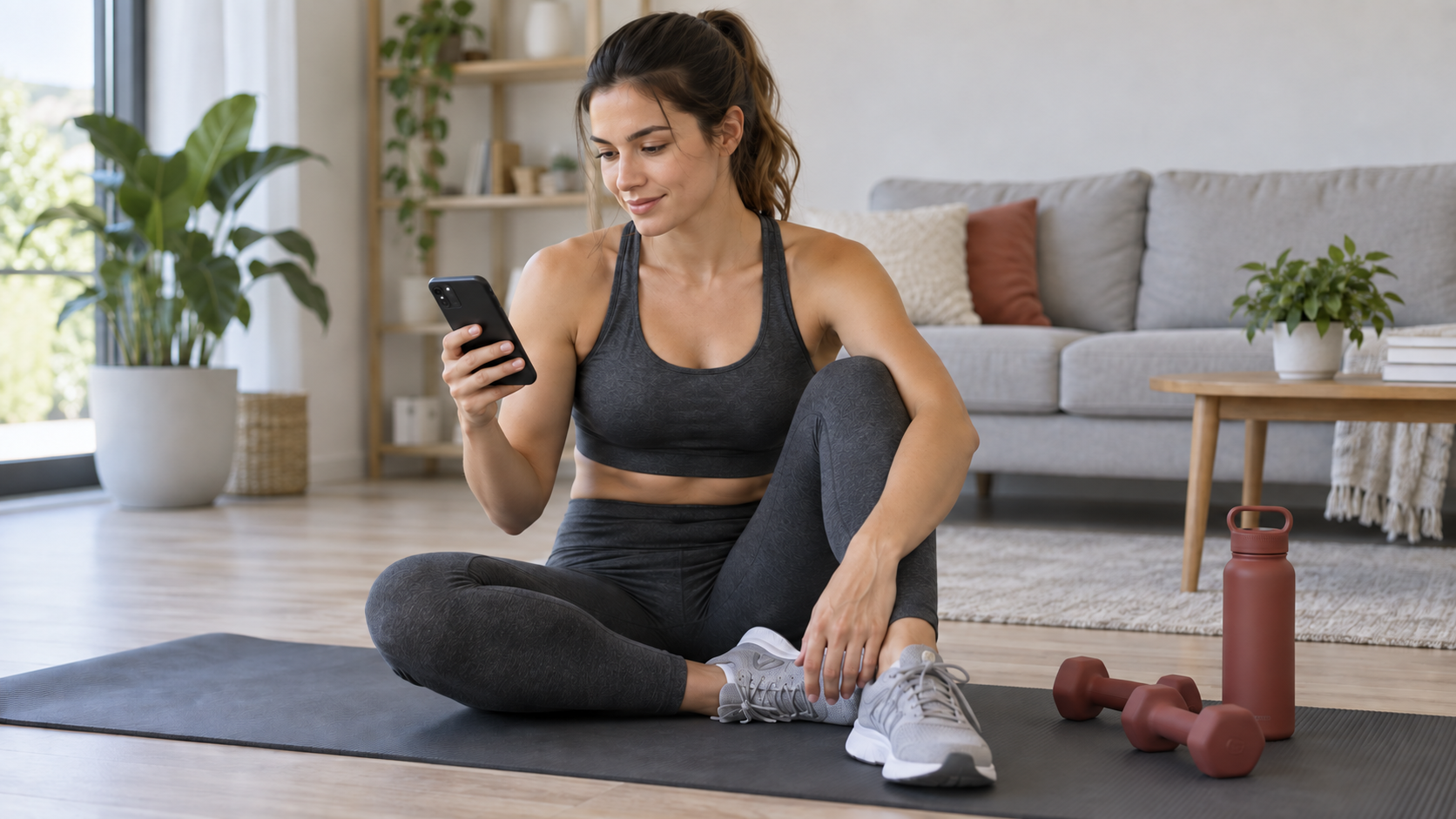
An app can give you a workout to do at home, in your neighborhood or while traveling. A body-weight session might use squats or lunges when weights are unavailable. Other activities may still need equipment or more room, so check the actual session.
Remote training can also include contact with a trainer or other exercisers. For example, Strava has offered ways to share running times and routes with peers, including finding routes in an unfamiliar area. Consider whether sharing progress is something you want, or whether you prefer a plan you can follow on your own.
The move toward remote fitness became especially visible during the COVID-19 pandemic. Work, school and social contact moved online, and fitness apps offered another way to exercise during lockdowns.
Can gamification help you keep exercising?
Gamification means using game-design features in another setting. In a fitness app, the aim is to give people a reason to return. Opening the app and doing the workout are both parts of that routine.
A 2014 study by Lister and colleagues examined game and behavior features in 132 health and fitness apps. It assessed their design, rather than following users over time to see how long they kept exercising.
When trying an app, notice what draws you back. Is it the workout, seeing progress or contact with other people? Look for features that help you do the activity, and keep the focus on a routine you enjoy.
What did lockdown research find about fitness apps?
Yang and Koenigstorfer’s 2020 study followed 431 healthy adults from 45 U.S. states through two online surveys, before and during lockdown. All already owned a smartphone and had downloaded at least one physical activity (PA) app. Participants reported their own activity and app use; the researchers did not assign a workout programme.
Overall activity, measured in MET minutes per week, fell by 18.2%. People who used apps more often tended to have smaller drops in activity. This relationship remained after the researchers accounted for earlier activity levels and intentions to be active.
The researchers wrote, “Our study revealed a positive effect of the usage of PA apps.” Game-related features were also associated with better maintenance of activity. The surveys covered several weeks of lockdown, showing how existing app users managed that disruption.
What support do you need to keep going?
Training alone can suit your schedule, but you may miss the company of a class or gym. A reminder on your phone can be easier to ignore than a running partner waiting for you. Think about who or what helps you show up.
You might use an app between sessions with a trainer, share workouts with a friend or follow a plan on your own. The choice can change when you travel or when your week gets busy. Make room for the kind of self-motivation that works for you, alongside any support you want from others.
Try a session in the setting where you will usually train. Could you follow it? Did the equipment and space work? Would you want to do it again? Those answers can help you choose a plan that earns a place in your routine.
References
Lister, C., West, J. H., Cannon, B., Sax, T., & Brodegard, D. (2014, August 4). Just a fad? Gamification in health and fitness apps. JMIR Serious Games, 2(2), e9. https://games.jmir.org/2014/2/e9/
García-Fernández, J., Gálvez-Ruiz, P., Grimaldi-Puyana, M., Angosto, S., Fernández-Gavira, J., & Bohórquez, M. R. (2020, September 18). The promotion of physical activity from digital services: Influence of e-lifestyles on intention to use fitness apps. MDPI. Retrieved November 30, 2022, from https://www.mdpi.com/1660-4601/17/18/6839
Yanxiang Yang, Joerg Koenigstorfer, Determinants of physical activity maintenance during the Covid-19 pandemic: a focus on fitness apps, Translational Behavioral Medicine, Volume 10, Issue 4, August 2020, Pages 835–842, https://doi.org/10.1093/tbm/ibaa086
“With new technology and the need for versatility, phone applications have begun to replace parts of our lives.”
“Much of this increase in the use of technology may be directly attributed to the Covid-19 pandemic that began in 2020.”
“The gamification of apps in the health and fitness arena offers an opportunity to influence the health behaviors of its users.”